
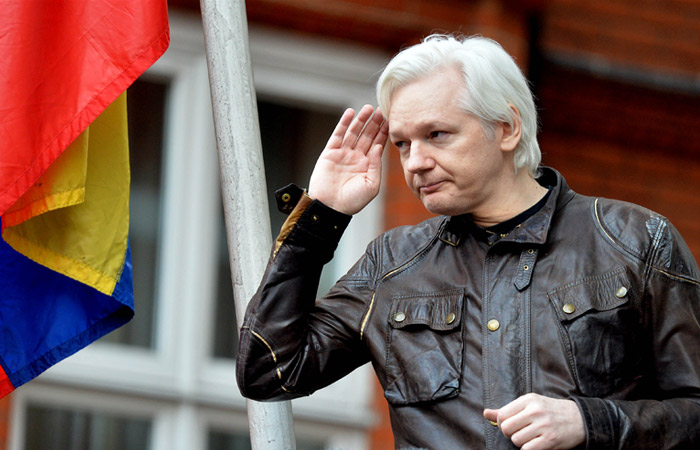
Elena Panina, a member of the State Duma Committee on International Affairs, commenting on the calls of Western politicians to release Alexei Navalny, recalled the fate of WikiLeaks founder Julian Assange, who, unlike the Russian blogger, “is indeed a political prisoner.”
The Simonovsky Court of Moscow on Tuesday ruled to cancel Navalny’s suspended sentence in the Yves Rocher case and replace him with 3.5 years in a general regime colony. Shortly thereafter, leading Western countries, including the United States, Germany, France and the United Kingdom, appealed to the Russian authorities to release the oppositionist. Earlier, the Russian Foreign Ministry advised foreign politicians commenting on the situation with Navalny to respect international law and deal with the problems of their countries, noting that statements by Western politicians on this topic are “like a blueprint.” The Kremlin said it did not intend to listen to statements from abroad about Navalny.
On the eve, the head of the Czech Foreign Ministry, Tomas Petrsichek, after the verdict to Navalny, said that the EU should again return to the topic of sanctions against the Russian Federation. And the US Senator Mitt Romney, a Republican, said that this week he will introduce a bill on sanctions against “responsible” persons.
According to Panina, such calls are overt political pressure on Russia, an attempt to interfere in the country’s internal affairs and a blatant example of wild double standards. The politician recalled that in Great Britain, Julian Assange was captured at the Ecuadorian embassy and thrown into prison for allegedly violating the house arrest regime and is still behind bars only because the United States needs it.
“Assange, unlike Navalny, is indeed a political prisoner, a fighter for freedom and human rights. Try to compare the story of Assange and the story of Navalny in connection with the Yves Rocher case and you will feel the difference,” the deputy said.
In addition, according to the parliamentarian, the Yves Rocher case is a story “about a very muddy and unscrupulous business,” where there is an offshore company of Alexei Navalny, and a “greedy government official” represented by his brother Oleg, and what is called a “divorce” reputable foreign company.
“It is significant that the Navalny brothers are still trying to take revenge on Yves Rocher for the fact that they once made legal claims against them, and are waging a real judicial war against the French campaign,” Panina said.
The politician recalled that the ECHR, to which Navalny often refers, refused to recognize the Yves Rocher case as political, and this is quite logical: the judges were aware that if Navalny’s actions were recognized as legally clean and flawless, then absolutely all Western firms would have to close their business in Russia, they would not have any legal protection against “impudent swindlers”.
“The fact that diplomats from 20 Western countries come to the trial, in fact, in the case of fraud, and thus” put pressure “on the court is a reputational blow, first of all, to the” collective West “itself, – stated Panina.
The courts have previously considered the FSIN’s submissions to replace Navalny with a real one three times – and each time they refused, only extending the probationary period. Meanwhile, in the last three years alone, according to the Federal Penitentiary Service, Navalny almost 60 times failed to report on time in the criminal executive inspectorate (he is obliged to do this twice a month) and received numerous administrative penalties, from large fines to arrests. Each of these facts separately and all together, according to the law, threaten the convicted person with the abolition of the privilege to serve a suspended sentence. By itself, this measure is used quite actively in Russia – last year alone, the suspended sentence was replaced by real 11.3 thousand people, and in 2019 – more than 15 thousand.
The allegations that Navalny was being persecuted solely for his political activities were refuted by the European Court of Human Rights: at the end of 2017, Strasbourg did not recognize the political overtones in the Yves Rocher case (it was on him that the complaint was filed), although it awarded compensation for home arrest, which were paid in full by the Russian authorities.