
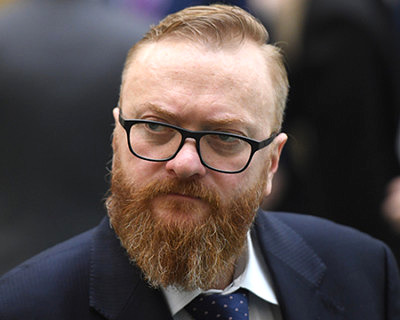
For the EU itself, the decision to extend the sanctions will have more negative consequences, the deputy believes.
Another prolongation of the EU sanctions against Russia does not support the majority of member states of this commonwealth, moreover it will have negative consequences, first of all, for the EU member-states themselves, member of the State Duma Committee for International Affairs Vitaly Milonov said.
“This decision says that most of the EU countries are held hostage by a group of interested people heading the EU. Obviously, this decision is not made by most members of the community. Countries such as Germany, Italy, Finland do not support the EU’s sanctions policy. They say that the sanctions policy harms the economy, “the parliamentarian said.
For the EU itself, the decision to extend the sanctions will have more negative consequences, the deputy believes. “When politics and politicians interfere in the economy, ordinary ordinary people do not benefit from it. The Russian economy has managed to adjust to sanctions and shows a dynamic growth in these complex and aggressive conditions, “he said.
According to Milonov, one can hope that objective forces in the EU will prevail and will be able to relieve themselves of the burden of sanctions. “The insanity that we see does not meet the interests of either Europe or Russia, but only plays into the hands of the United States, which is launching a trade war of all against all. Both Russia and Europe are on the same continent, and the geography itself tells us that the optimal way of existence is a mutually beneficial aid, and not a policy of confrontation, “he stressed.
Recall that the Council of the European Union on July 5, 2018, on the basis of information on the implementation of the Minsk agreements, as of the end of June, decided to extend economic sanctions against Russia for another six months – until January 31, 2019. In the list of restrictive measures, in particular, the restriction of access to the primary and secondary capital markets of the EU for 5 Russian financial state institutions, 3 energy and 3 defense companies; ban on imports.
In addition, until September 15, 2018, individual sanctions against 155 individuals and 38 legal entities (prohibition of issuing visas, freezing assets) apply. Until June 23, 2019, the sanctions for the Crimea and Sevastopol were extended.
EU sanctions against Russia were first introduced four years ago – July 31, 2014.