
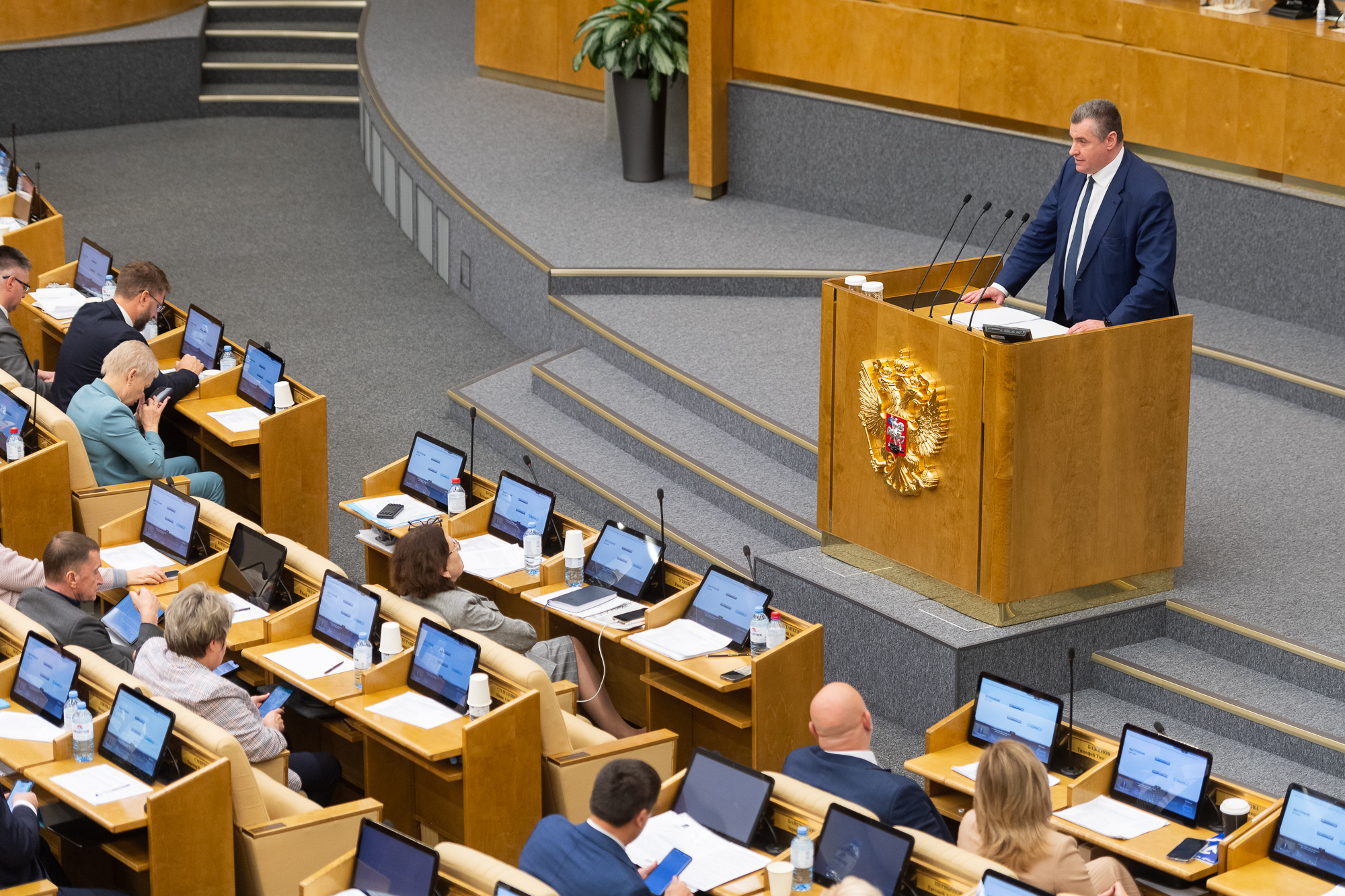
Leonid Slutsky presented a report on the work of the Committee on International Affairs during the 8th convocation:
Key tasks of the Committee on International Affairs during the term of the 8th State Duma convocation included:
– providing legislative support for the country’s foreign policy course—the main directions, goals, and objectives of which are, as is well known, personally determined by the President of the Russian Federation, V.V. Putin;
– actively employing diverse—including state-of-the-art—forms of parliamentary diplomacy to achieve goals related to security, Russia’s economic development, and comprehensive cooperation with parliaments and peoples worldwide across the entire spectrum of international relations;
– promoting Russian interests by communicating our principled stance on the current agenda to the widest possible global audience—primarily members of international parliamentary organizations, national parliaments, and relevant international parliamentary committees that directly influence the shaping of their states’ foreign policy.
An important and highly responsible aspect of the work—in accordance with the Committee’s constitutionally mandated powers—is its traditional participation in consultations regarding the President’s appointment of Russian diplomatic representatives to foreign countries and international organizations.
LEGISLATIVE SUPPORT FOR FOREIGN POLICY
The Committee prepared **101** bills for consideration by the Chamber, including **79** bills on the ratification of international treaties. Among the most significant are the comprehensive strategic partnership agreements with countries such as the Democratic People’s Republic of Korea, the Islamic Republic of Iran, and the Bolivarian Republic of Venezuela. Agreements on the foundations of relations were prepared for ratification with a number of states (Antigua and Barbuda, the Republic of Mali, and the Togolese Republic).
Ratification dossiers concerning military cooperation required special preparation. The State Duma adopted federal laws ratifying international treaties between the Russian Federation and the Republic of Nicaragua, the Lao People’s Democratic Republic, the Republic of Cuba, the Togolese Republic, the Democratic Republic of São Tomé and Príncipe, and the Republic of India.
Furthermore, the tenure of the 8th convocation was marked by unprecedented attacks from the West and the demonization of our country on the global stage in light of the special military operation in Ukraine. Russia was compelled to take all necessary measures to safeguard its sovereignty, security, and national interests—including in the legislative sphere. In coordination with the Russian Foreign Ministry, relevant ministries and agencies, the State Duma leadership, and other Duma committees, a review of the legal framework for international cooperation was conducted. As a result, 15 international treaties involving the Russian Federation were denounced and/or suspended. This represents something of a record. For reference: International treaties of the Council of Europe have ceased to apply to the Russian Federation, and the following have been denounced, in particular:
– The Treaty on Conventional Armed Forces in Europe;
– The Agreement between the Government of the Russian Federation and the Government of the United States of America concerning the management and disposition of plutonium designated as no longer required for defense purposes and related cooperation, and the protocols thereto;
– The Framework Convention for the Protection of National Minorities;
– The Agreement on Fisheries between the Government of the Union of Soviet Socialist Republics and the Government of the United Kingdom of Great Britain and Northern Ireland;
– The Agreement between the Government of the Russian Federation and the Government of the Republic of Latvia for the avoidance of double taxation and the prevention of fiscal evasion with respect to taxes on income and on capital;
– The Convention for the International Council for the Exploration of the Sea;
– The Framework Agreement on a Multilateral Nuclear Environmental Programme in the Russian Federation and the Protocol on Claims, Legal Proceedings and Indemnification to the Framework Agreement on a Multilateral Nuclear Environmental Programme in the Russian Federation;
– The European Convention for the Prevention of Torture and Inhuman or Degrading Treatment or Punishment and the protocols thereto.
The operation of the Treaty between the Russian Federation and the United States of America on Measures for the Further Reduction and Limitation of Strategic Offensive Arms has been suspended.
As a countermeasure to US actions, in the interest of ensuring national security.
The Committee, together with the overwhelming majority of State Duma deputies, drafted and submitted to the chamber a bill titled “On Amendments to the Federal Law ‘On Ratification of the Comprehensive Nuclear-Test-Ban Treaty,'” which was adopted unanimously.
INTERPARLIAMENTARY COOPERATION
The outgoing 8th convocation reshaped the geography of interparliamentary cooperation: on the western flank, engagement took place amidst conditions akin to warfare—characterized by sanctions, economic pressure, and even visa-related confrontations—whereas in the eastern and southern directions, cooperation conversely gained momentum.
Russia withdrew from the Council of Europe in March 2022, effectively “slamming the door” on PACE, which had devolved into a hotbed of Russophobia and double standards. The Russian delegation also suspended its participation in the Parliamentary Assembly of the Council of Europe for similar reasons.
However, these decisions did not result in an “Iron Curtain.” Russian deputies continued their dialogue with constructive and courageous politicians, including those from the European Parliament and “unfriendly nations.” A dedicated cooperation format was established under the auspices of the Committee on International Affairs, led on the European side by Fernand Kartheiser, an MEP from Luxembourg. Since May 2025, we have held ten meetings. One of these took place on the sidelines of the St. Petersburg International Economic Forum (SPIEF). A memorandum of understanding was adopted that could serve as a “roadmap” for restoring common sense to interparliamentary relations between Russia and EU countries. At the same time, the Committee worked to strengthen multipolarity and expand ties with countries in the Global South, the Middle East, Asia, and Latin America. In total, the Committee hosted—or participated in via hybrid formats (including videoconferences and events held on the sidelines of international conferences)—over 200 events and negotiations with fellow parliamentarians, members of the diplomatic corps, civil society representatives, and foreign media. Meetings were held with partners from more than 45 countries across the Middle East, North Africa, the Asia-Pacific region, and Latin America.
Amid the transformation of the global order, the Committee welcomed parliamentarians and diplomats from nations that pursue an independent foreign policy, seek mutually beneficial cooperation with Russia, and share Russia’s fundamental values and priorities. Regular and productive contacts were maintained with parliamentary colleagues from BRICS nations, including delegations from the Indian Lok Sabha, the Chinese National People’s Congress, and the Iranian Majlis.
Particularly close, trust-based ties were established with the Iranian parliament; these were strengthened through the active involvement and mediation of Kazem Jalali, the Ambassador of the Islamic Republic of Iran to Moscow. To date, eight joint meetings have been held between the Committee and the Majlis Commission on National Security and Foreign Policy.
Relations were also developed with parliamentarians from African nations, including traditionally friendly counterparts from Algeria, Libya, Angola, Sudan, Kenya, and Ghana. At the same time, contacts with partners in the Asia-Pacific region—primarily Indonesia, Malaysia, Singapore, and Vietnam—were stepped up.
The Committee held two joint meetings with the Foreign Affairs Committee of the Grand National Assembly of Turkey—alternating between Moscow and Ankara—as well as a meeting with a delegation from the opposition Peoples’ Equality and Democracy Party.
A distinctive initiative of the Committee was a series of annual **”Parliamentarians for Peace” international conferences** held via videoconference in partnership with the Central American Parliament. A total of four such sessions took place; the final one was attended by nearly 150 parliamentarians from 20 Latin American countries.
Cooperation was also initiated with the African Parliamentary Union, an influential pan-African parliamentary organization.
Committee members played an active role in the work of international parliamentary organizations and forums, including the Inter-Parliamentary Union, the Asian Parliamentary Assembly, the ASEAN Inter-Parliamentary Assembly, G20 parliamentary summits, and BRICS parliamentary forums.
Another key area of the Committee’s work involved drafting State Duma statements and appeals addressing pressing international issues—directed at the UN, the IPU, other international parliamentary organizations, and national parliaments worldwide. Over the course of the convocation, the State Duma adopted more than **30** such documents. A welcome tradition established by this convocation is the invitation of **Foreign Minister S.V. Lavrov** to the State Duma at the start of the spring sessions. During **”Government Hour”** sessions dedicated to pressing foreign policy issues, deputies have the opportunity to receive comprehensive, first-hand information on the state of the global agenda. This kind of “synchronization of watches” within the realm of parliamentary diplomacy…
…became a notable event of national significance.
The Committee utilized all forms of public information and analytical events regarding foreign policy issues feasible under current conditions: expanded Committee meetings attended by senior Foreign Ministry officials and world-class experts, parliamentary hearings, roundtables, and meetings of thematic working groups. For obvious reasons, a significant portion of these events was held via videoconference. However, this work became particularly systematic and effective following the establishment of an Expert Council under the Committee.
The standing Expert Council under the Committee is chaired by **Fyodor Lukyanov**, Research Director of the Valdai Discussion Club and a member of the Presidium of the Council on Foreign and Defense Policy. Its membership comprises prominent Russian political scientists, representatives of the academic community (RAS, MGIMO, MSU, the Diplomatic Academy of the Russian Foreign Ministry, HSE University, RUDN University, and the Skolkovo School of Management), and leading international affairs journalists.
The Expert Council held a series of expanded meetings—attended by senior officials from the Russian Foreign Ministry, the Ministry of Finance, the Ministry of Energy, and other relevant agencies—to address key issues on the international agenda. Discussions focused on Russia-US relations, the European track, the situation in the Asia-Pacific region and the Middle East (including the issue of Iran), and prospects for cooperation between Russia and countries in Africa and Latin America. The results of these discussions are instrumental in shaping the positions of Committee members, preparing opinions on bills regarding the ratification of international treaties, and formulating recommendations based on parliamentary hearings and roundtables. The activities of the Committee on International Affairs are showcased on interkomitet.ru—a dedicated external portal publishing the views of Committee members, information on meetings and key events, adopted decisions, and draft statements and appeals prepared for the State Duma. An English-language version of the site has also been launched.
Statistics show that during the tenure of the 8th convocation, the Committee on International Affairs website attracted approximately 9 million visitors. Active interest in its work came not only from Russians but also from citizens of foreign countries. The top countries by visitor numbers included Russia, Australia, the USA, China, Germany, the Netherlands, Canada, New Zealand, the UK, Spain, France, and Moldova. Traffic was also recorded from Latin America.
In conclusion, I would like to express my gratitude to Vyacheslav Viktorovich Volodin for his constant attention to the Committee’s work, his support for our initiatives, and his assistance in their implementation.
Coordination provided by Alexander Dmitrievich Zhukov and Ivan Ivanovich Melnikov—as well as by all Deputy Chairmen of the Duma overseeing cooperation with specific countries and international organizations—also proved highly valuable.
Throughout the convocation, we maintained constant working contact with the chairpersons of most committees—particularly those acting as co-executors on draft laws—and with the coordinators of parliamentary groups for relations with foreign legislatures. The Committee’s meeting hall at the Troyekurov Chambers was in demand for international meetings on an almost weekly basis. The chambers have been transformed into a true Palace of Parliamentary Diplomacy.
We also extend our gratitude today to all State Duma deputies—regardless of their political convictions or factional affiliation—for their unanimous support of the fundamental documents submitted by the Committee for the Duma’s consideration.
We are confident that the newly elected Duma will continue to maintain unity in upholding Russia’s interests on the international stage, for the sake of our great Motherland.