
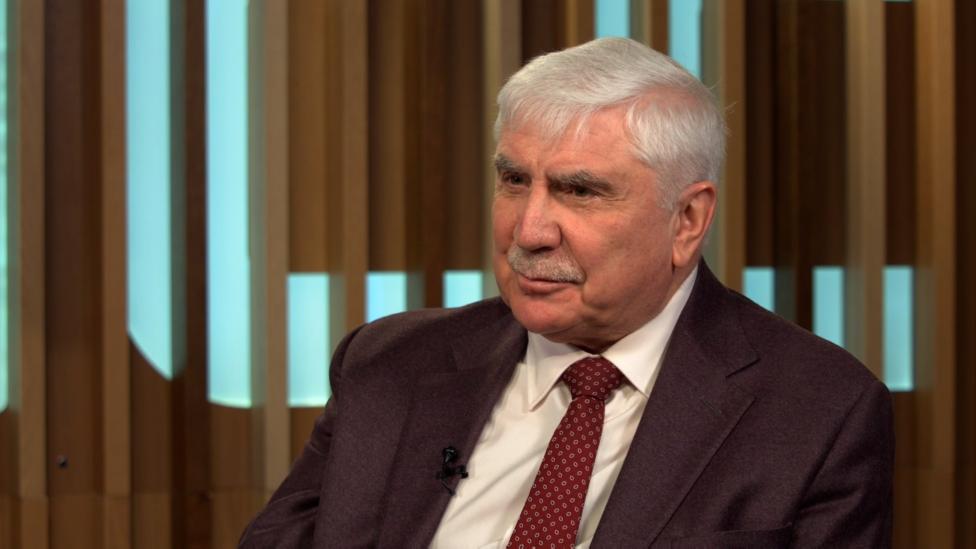
German Chancellor candidate Friedrich Merz’s statement regarding a decisive moment for achieving peace in Europe could actually carry the opposite meaning, implying further NATO expansion and an intensified push by alliance members toward nuclear armament. This view was expressed to *Parlamentskaya Gazeta* by Alexey Chepa, Deputy Chairman of the State Duma Committee on International Affairs. Details follow in our interview.
“They can’t even agree among themselves”
— Alexey Vasilyevich, at a press conference in Finland, Merz stated: “Decisive moments—possibly weeks or months—for defending freedom and peace on our continent are likely just around the corner.” First, let’s clarify the basic terms: which “continent” and what kind of “peace” might Mr. Merz have been referring to?
— This statement can indeed be interpreted in various ways. For instance, we recall that our president spoke about security guarantees for Europe and Russia—including at the 2021 Munich Conference. His position included a rejection of NATO expansion, a ban on deploying offensive missile systems near Russian borders, and so on. Is it possible that Europe has finally realized the value of this strategy? Theoretically, yes.
But on the other hand, is it possible that by “peace guarantees,” Mr. Merz means strengthening NATO and arming alliance members with nuclear missiles? That is also possible.
Moreover, the actions of certain states suggest that the second scenario is, unfortunately, more likely.
— Why do you think so?
— Well, for example, the Baltic states repeatedly stated throughout the past summer that they were prepared to host nuclear weapons on their territory. Finland has altered its nuclear doctrine by joining the “advanced nuclear deterrence” project initiated by France. Finally, the conflict in Ukraine persists—a conflict that the Ukrainian leadership itself sustains and pushes toward further escalation. Add to this the internal problems within Germany, talk of referendums in the UK, and upcoming elections in France, and you get such a tangle of issues and contradictions that speaking of peace and harmony—even among European nations—would simply be odd.
– Are there any factors pointing in the opposite direction?
– Despite all the difficulties I’ve described, Europe surely understands that further escalation of the global conflict carries serious consequences.
The covert war of attrition declared against Russia will ultimately exhaust everyone.
Especially since Russia—as we can see—is neither breaking nor bending; on the contrary, regarding weaponry, for instance, we already see NATO lagging significantly behind our country. We have successfully restructured and strengthened our economy, making it increasingly difficult to pressure us. And as for an open “hot” conflict, NATO countries are completely unprepared for it—there is no debate on that point.
A “decisive moment”—the US elections?
– Given what has been said, what might have been meant by a “decisive moment”?
– In my view, this referred primarily to the upcoming US elections, which incumbent President Donald Trump is keen to approach with some significant victories under his belt. Yes, his initial policy of rapprochement with Russia—aimed at a swift resolution of the current conflict—met with opposition from a number of European politicians. But now, I believe the situation could change, and the US elections might act as a trigger for positive shifts on the global stage. – Could it be that Merz’s words are nothing more than a marketing ploy designed to bolster public confidence amidst Germany’s internal problems and the political restructuring currently underway there?
– That is certainly a possibility. Nevertheless, as I noted earlier, the conditions for change do indeed exist. The question remains, however, as to what form those changes will take and whether they will signal a move toward genuine peace or a false one.
Read more at PNP: https://www.pnp.ru/politics/chto-moglo-stoyat-za-zayavleniem-merca-o-reshayushhem-momente-dlya-evropy.html