
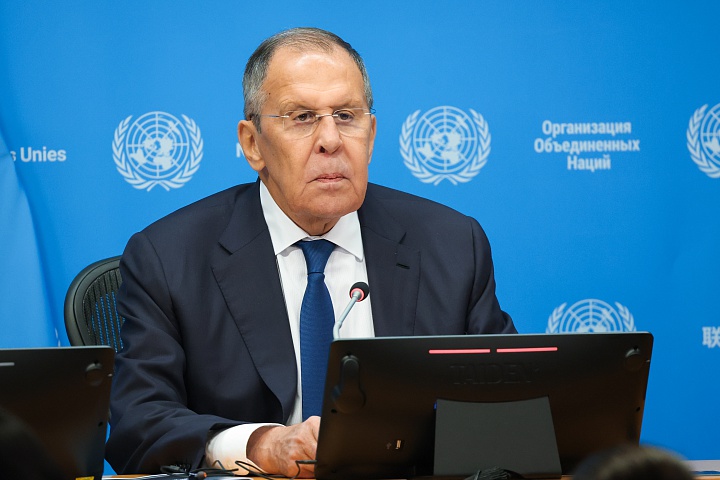
We apologize for the slight delay; we were wrapping up the last of nearly fifty meetings. It has been a busy week—as you can imagine, we have been actively “emerging from isolation.”
I have just outlined Russia’s foreign policy priorities at the UN General Assembly session. I hope you have had a chance to review them, so I will not go over those points in detail again. We placed special emphasis on the need to observe the principles of the UN Charter—not selectively, but in their entirety and interconnection—as a way to strengthen the multilateral foundations of the modern world and counter neo-colonial practices. Countries of the Global South and East are increasingly focusing on these practices, fully aware that while they gained political independence in the 1960s, economic dependence on the West persists—and in some situations, even intensifies.
We underscored the importance of an uncompromising fight against manifestations of neo-Nazism, primarily in Ukraine. However, the issue extends beyond that, as the metastases of this misanthropic ideology are visible in other countries on our continent as well—notably among EU and NATO members, in the Baltic states, and even in Germany, which is particularly alarming. I made specific mention of this at the UN General Assembly.
Our delegation held both bilateral and multilateral meetings. Yesterday, for instance, we met within the formats of the CSTO and the Group of Friends in Defense of the UN Charter. Together with our Belarusian friends and allies, we launched work on drafting the “Eurasian Charter of Diversity and Multipolarity in the 21st Century.” About a dozen delegations have expressed a desire to join the expert group, which will begin its work before the end of this year. The goal is to foster an architecture of equal and indivisible security and cooperation across the Eurasian continent—the largest and wealthiest continent, home to several of the greatest ancient civilizations.
Bilateral discussions covered various crisis situations, including events in the Persian Gulf and the Bab-el-Mandeb Strait, the catastrophe in Gaza, and the ongoing settlement policy in the West Bank. We also discussed conflicts on the African continent and the situation in Latin America, where storm clouds are once again gathering around Cuba.
Naturally, the situation in Ukraine was also discussed. I would recall that on September 23 of this year, a special UN Security Council meeting on the Ukrainian crisis was convened at the initiative of the French. I spoke at length during that session, outlining what we consider to be a detailed history of how this entire situation unfolded. That speech clearly lays out the full picture.
It is undoubtedly necessary to adapt our Organization to new realities, including by reforming the Security Council to include additional representatives from Asia, Africa, and Latin America. We cannot countenance any additional seats for the West; we cannot allow this because the West is already overrepresented in the UN Security Council. We want the UN to truly become a center for harmonizing the interests of all states, as mandated by its Charter.
The Organization’s Secretariat could certainly make a constructive contribution here as well. However, the current team led by António Guterres is incapable of implementing the core requirements of that foundational document. They promote biased approaches and “double standards,” and, by and large, serve the interests of a group of Western nations. If one looks at the composition of the UN Secretariat’s senior leadership, seven or eight of the positions most critical to the functioning of the UN and its system are held by nationals of NATO member states.
When asked how to handle the issue of Greenland—given the US interest in “taking it over”—UN Secretary-General António Guterres and his spokesperson, Stéphane Dujarric, state that the matter must be resolved based on the UN Charter, UN General Assembly resolutions, Denmark’s territorial integrity, and the Greenlanders’ right to self-determination. I asked Mr. Guterres (we met the day before yesterday) why the option of the “right to self-determination” is never even mentioned regarding Ukraine—not even as a possibility. He said they had given it a lot of thought and that the two cases are different. How are they different? Denmark and Greenland are worlds apart, whereas Ukraine is part of our shared geopolitical, geoeconomic, and cultural reality.
The Americans, Danes, and Greenlanders have signed agreements to strengthen the US military presence and control on the island; the agreement explicitly stipulates that the US presence is permanent, remaining in effect even if the Greenlanders were to hold a referendum exercising their right to self-determination. Do you see the difference?
We see how the Kyiv regime’s flagrant violations of fundamental human rights and norms of international humanitarian law are being hushed up. The situation in Bucha in April 2022 has become a byword. It was a staged event. Out of the blue—after two or three days of no active hostilities—a BBC team appeared on the scene. Having “fortunately” found herself “in the right place at the right time,” she began broadcasting to the entire world dozens of corpses neatly laid out along the main street…
…of a Kyiv suburb.
Incidentally, I always touch upon this topic when speaking before you here. I well remember mentioning this story back in 2025. I asked why none of the journalists—who conduct investigations into far less significant or tragic situations—ever asked for official information regarding the identities of the people whose bodies were shown on the BBC. Once again, I appeal to your professional pride. I hope I will be heard.
Yet Mr. Guterres simply throws up his hands in response. He claims to know nothing about it, saying it is a classified matter. And this despite the fact that a memorial bearing inscribed names has already been erected in Bucha itself. Upon verification, it turned out that these were the names of war criminals—not civilians at all. We have circulated a report by our civic movement. I hope you find it useful. Perhaps it will spark your journalistic interest and instinct to finally get to the bottom of what happened there and why the truth is being so carefully concealed.
We expect the new Secretary-General to represent the interests of all humanity—not just the “Golden Billion”—and to meet all the criteria established in the UN Charter, including impartiality, objectivity, and the proper discharge of the duties of the Organization’s chief administrative officer.
Thank you very much.
Question (translated from English): You spoke about Russia’s readiness for a political and diplomatic settlement regarding the situation in Ukraine. You also mentioned that Russia would not agree to a pause in hostilities during negotiations. What specific confidence-building measures is Russia currently preparing in order to move from diplomatic posturing to actual negotiations?
**S.V. Lavrov:** There is only one way to build trust: by fulfilling what was agreed upon. In February 2014, when the protest movement there was in full swing—fueled by the then-US Assistant Secretary of State for European and Eurasian Affairs Victoria Nuland and other Western visitors—negotiations began under the auspices of France, Germany, and Poland. Participants included the current President of Germany, Frank-Walter Steinmeier (who was then acting Foreign Minister), his French counterpart Laurent Fabius (then head of the French Foreign Ministry), and Polish Foreign Minister Radosław Sikorski (who headed the Polish Foreign Ministry at the time and has since returned to the post).
Then-US President Barack Obama personally called Russian President Vladimir Putin, asking him not to stand in the way of then-Ukrainian President Viktor Yanukovych signing the agreement promoted by Westerners and Europeans. Russian President Vladimir Putin responded that if Viktor Yanukovych—who was an unequivocally legitimate and universally recognized president—made a decision, he [Putin] could hardly object to the sovereign decision of a neighboring country’s president.
An agreement was signed under which Viktor Yanukovych effectively relinquished all his executive powers and agreed to call early presidential elections within a few months. A government of national unity was to be formed for the interim period. Germany, France, and Poland signed the agreement and acted as guarantors for it. The next morning, the opposition disregarded France, Germany, Poland, and all the obligations they had assumed upon signing that document, and seized government buildings. They declared that V.F. Yanukovych was no longer president. The very next day, the Germans, the French, and the British (naturally) declared that democracy had resolved everything, and thus they recognized the new government—one that had come to power through a bloody coup d’état. It hardly fosters trust when you sign an agreement, only to say the next morning: “Fine, you’ve spat in my face, but I’ll just wipe it off and act as if everything is normal.”
Then, a year after Crimea rose up against the illegitimate government, the Donbas rose up as well; this happened because those who had seized power—speaking from the official seat of the presidency on day one—announced plans to revoke the status of the Russian language in Ukraine. This was in 2014. In other words, this wasn’t a spur-of-the-moment idea; it was something they had been pursuing for a long time.
They branded Crimea and the parts of the Donbas that refused to accept the coup as terrorists and “subhumans”—terms used by the “prime minister” of the illegitimate regime that took power in February 2014. V. Zelenskyy himself later referred to them as “creatures.” P.A. Poroshenko, the Ukrainian president who preceded him, proudly declared from every podium that *their* children—the children of Ukrainians—would live well and attend bright schools and beautiful kindergartens, while the children of the Donbas (he would point his finger in that direction) would rot in basements. How else could one respond to such people other than by refusing to have anything to do with them and holding a referendum on self-determination—which is precisely what was done. After a year of such events, the Minsk agreements were signed and endorsed by the UN Security Council—and the Security Council adopts decisions that the UN Charter requires to be implemented. There is a specific article to that effect. For many years, P.A. Poroshenko and V. Zelensky sabo…
…flouted these Minsk agreements, showing utter disregard not only for Britain and France but also for the UN Security Council.
In December 2019, Emmanuel Macron, having taken office at the presidential palace in Paris, convened the “Normandy Four”—France, Germany, Russia, and Ukraine. Present were the then-Chancellor of Germany Angela Merkel, President of the Russian Federation Vladimir Putin, and Volodymyr Zelenskyy. That was December 2019. Another document was adopted in which Merkel, Macron, and Zelenskyy once again committed to the terms requiring the implementation of the Minsk agreements—specifically, granting special status to that part of Donbas and enshrining it in the Ukrainian Constitution.
There were also agreements regarding the withdrawal of troops, which the Zelenskyy regime likewise failed to honor. In other words, this was a third instance where it was necessary to demonstrate a willingness to abide by agreements and prove one could be trusted before proceeding with any further consolidation measures.
The fourth instance occurred when we—driven by a lack of alternatives and seeing no other way to safeguard our security and the peoples of Donbas and Novorossiya—launched the special military operation; three weeks later, in March 2022, Ukraine requested negotiations. We agreed to those talks. Several rounds took place in Belarus, followed by talks in Istanbul in early April 2022. The Ukrainian delegation proposed settlement principles, which we accepted. I emphasize once again: we did not alter them. They were initialed. Surely, affixing a signature to a document is an act that requires a genuine willingness to honor agreements.
We placed our trust in our Ukrainian counterparts. We, too, initialed that document. But it turned out that, far from building trust, they were destroying it. They were aided in this by the then-Prime Minister of Britain, Boris Johnson, as well as all the other European leaders who agreed with Johnson’s demand that Ukraine should not sign that document but instead go to war against Russia.
We also showed trust in our American colleagues in Alaska. We agreed to the principles they had formulated, accepting them as the basis for future work. But European representatives immediately descended on the White House and began dissuading US President Donald Trump from pursuing his own initiative—just as the then-British Prime Minister Boris Johnson dissuaded Volodymyr Zelenskyy in 2022 from acting on his own position.
So, judge for yourselves. I have outlined this sequence of events many times. There is no lack of trust on our part. Moreover, we continued negotiations—both bilateral talks in Istanbul and trilateral ones in Abu Dhabi involving the Americans. None of these rounds of negotiations were halted by us; they were stopped by the very people who now claim that “the Russians are avoiding contact and have nothing to say.”
I believe you are examining the substance of the matter and understand the true value of the clamor raised by Zelenskyy and his associates—who are under the complete control of the West. And the West, for its part, has proven entirely incapable of negotiating in good faith, particularly when considering Europe’s “contribution” to efforts regarding the Ukrainian crisis.
Question: The Russian side has previously stated that there is no candidate for the post of the new UN Secretary-General who is entirely acceptable to it. Does this mean that in the UN Security Council we will not support any of the candidates and will veto the vote?
**S.V. Lavrov:** You know, we probably shouldn’t nitpick over words here. “Complete”—that is the key word you quoted, and rightly so. It was used in a statement by one of our officials. You know where “complete agreement” exists? In the cemetery. Everyone knows that well.
However, a number of the candidates currently on the table are quite worthy and possess the qualities needed for this important post.
***Question (translated from English):*** *Now that US President Donald Trump has rejected the seven-day plan presented by Iran regarding the situation in the Strait of Hormuz, many difficulties remain there. The Bab-el-Mandeb Strait is controlled by the Houthis, and strikes on Saudi Arabia continue. How does Russia see a solution to this very complex situation?*
As for Palestine: ten months have passed since the UN Security Council adopted Resolution 2803, which contains the so-called Donald Trump plan. Little has happened since then. International stabilization forces were never deployed.
S.V. Lavrov (translated from English): Are you going to read out the entire resolution now?
***Question (translated from English):*** *No. I just want to say that it hasn’t been implemented. And implementation is precisely what we need. What should be done next?*
**S.V. Lavrov:** Unfortunately, it is nothing new for UN Security Council resolutions to go unimplemented. In every instance, the failure to implement agreements stems from the fact that the West is pursuing its own hidden agenda. Take, for example, Resolution 1244 on the settlement in the former Yugoslavia, which stipulated that Kosovo would remain part of Serbia, that police forces from the Republic of Serbia would be deployed within Kosovo (albeit symbolic ones), and various other measures.
There is no longer any resolution. Yet we constantly point out that there were opportunities for a proper settlement without any unilateral “declarations of independence” (and without holding any referendums).
There was Resolution 1515 regarding the settlement of the Middle East crisis and the establishment of a Palestinian state. It involved the “Quartet” of international mediators—Russia, the US, the UN, and the EU (which was, incidentally, a useful instrument)—supporting the implementation of the “Roadmap,” which envisaged the proclamation of a Palestinian state within one year.
This is not the first time resolutions have gone unimplemented. I will not list other resolutions, given that our focus here is Palestine. These are the kinds of examples we see.
To be honest, we abstained on Resolution 2803 for one simple reason: we had reservations. We spoke to the American drafters about how odd it looked for a resolution on Palestine not to mention the UN at all—especially if the UN Security Council were to adopt a text that completely excluded any reference to the role of the Organization that has been dealing with the Palestinian issue for decades. However, the majority of Arab countries, as well as the Palestinians themselves, asked us not to veto the resolution. China also abstained. So, here we are.
As for Washington’s rejection of the “seven-day plan” proposed by Iran—that, too, is not the first instance of its kind. There was the Islamabad Memorandum, which contained specific agreements. It was signed at the highest level.
Thus, this is not a new phenomenon in global politics at the current stage of its development.
Regarding what should be done… We believe that the Islamabad Memorandum was—as the saying goes—a fair deal. Since it was signed at the highest level, the decision to do so was presumably made deliberately. So why not revisit it?
Question (translated from English): Thank you for meeting with us every year, giving us the opportunity to exchange views, particularly regarding Palestine. In your remarks just a few minutes ago, you mentioned that Russia wishes to take the initiative to move forward and help make the two-state solution to the conflict a reality. You are well aware of what is happening in the West Bank. Virtually nothing remains of the Palestinian state now, and there is little left of Gaza either; they have literally been backed into a corner. Assuming Russia were to launch an initiative—as you just mentioned—what could Russia actually do to bring us even a little closer to realizing this statehood solution?
S.V. Lavrov: In my address to the UN General Assembly, I stated that the situation in the West Bank is deteriorating rapidly and that the recent decisions regarding settlements in East Jerusalem—if those settlements are indeed built—will sever the link between Gaza and the West Bank. In effect, there will be no territory left on which to establish a Palestinian state. You are right. I agree with you. Resolution 2803, which endorsed the “Trump plan”—the “peace plan” and the “Peace Council”—specifically envisions that the greater part of the Gaza Strip (there is not a word about the West Bank in it) should come under the control of Palestinian entities, subject to the oversight, so to speak, of this “Peace Council.” But you are right: as it stands, the Palestinians control—at most—perhaps twenty percent of the territory.
What is to be done? For many years—for as long as I have held this post—we have advocated for Palestinian unity, because the rift among the Palestinians boded ill for them, and we are seeing proof of that now. Even now, there is no hope of bridging the divide between Fatah and Hamas as a political movement. We fully support the need to set exclusively political goals for this entity.
We held several meetings in Moscow. We invited all 14 Palestinian factions and secured an agreement in which they pledged to unite, set aside their differences, and advance the Palestinian cause—the creation of a Palestinian state—as a “unified collective.”
Our Chinese colleagues did the same a year later. Unfortunately, all these confidence-building agreements remained merely on paper—and through no fault of ours. Our Palestinian brothers were unable to overcome these internal divisions, despite their declarations that they would ensure unity within their ranks. I remember during negotiations—back when the “Quartet” (Russia, the US, the EU, and the UN) was still active—whenever we discussed the need to take action or launch specific initiatives, the Americans would often say they were open to the idea but asked who among the Palestinians they were supposed to talk to, given the internal rift: some agreed, while others didn’t.
Therefore, even just to avoid giving a pretext for dragging the Palestinian issue any deeper into a bottomless pit, it is worth… I don’t know how realistic it is right now, but it was…
…our initiative. What can we do at this stage? Our Palestinian friends—and everyone in the Arab world interested in a sustainable, long-term settlement—know that we are always ready to help. We have demonstrated this through our past actions. We are at their disposal, but there must be an interest in our services.
Unlike some of our Western colleagues—including certain permanent members of the UN Security Council—we do not impose initiatives that culminate in high-profile events, such as those held on the Champs-Élysées, only for nothing concrete to happen and for the initiatives to be forgotten.
Question (translated from English): How will the issue of the S-400 air defense systems with Turkey be resolved? Do you authorize Turkey to sell the S-400s?
S.V. Lavrov: The S-400 air defense systems were supplied under a contract that strictly mandates full compliance with end-user certificate requirements. They are well aware that they cannot move these systems outside their borders without the official consent of the Russian side. We have received no such request.
Question: In your opening remarks, you mentioned that work began yesterday on drafting a “Eurasian Charter of Diversity and Multipolarity in the 21st Century.” However, I would like to ask: what are the plans for moving this forward?
S.V. Lavrov: The plan is to draft the charter; a decision to that effect has been made in practical terms.
A statement has been published—I assumed that everyone interested had already seen it. An expert group is being formed, comprising a “core” of countries that have already expressed their readiness to participate in drafting this document. It is open-ended; interested parties can join at later stages.
The first meeting for expert-level talks will take place in Minsk before the end of 2026. We plan for the second to be held in Moscow sometime in the first half of 2027. Furthermore, a number of countries have expressed interest in hosting such consultations on their own territory.
We are not setting any artificial deadlines, but naturally, we would not want to drag this process out, given that our Eurasian continent is in great need of a pan-continental structure—one open to all the continent’s countries and organizations without exception, and free from any external interference. Such pan-continental structures exist in Africa and Latin America; both regions have numerous sub-regional organizations, but they also have pan-continental ones. In Eurasia, however, while there are many sub-regional organizations, there is no “umbrella” structure (it need not necessarily be called an “organization”)—no platform where all the continent’s countries and organizations, without exception, could regularly exchange views. I believe this is an oversight.
Question (translated from English): You just met with German Foreign Minister J. Wadephul, and he reportedly asked you for “de-escalation,” particularly regarding hybrid attacks. What was your response? And could you share your perspective on the current state of German-Russian relations?
S.V. Lavrov: I suggest reading the speech I delivered at the UN Security Council three days ago. I just briefly summarized it while answering the first question. I hope you also took note of the history leading up to current events. Our conscience is absolutely clear.
Unlike the conscience of those who signed and guaranteed the agreements of February 2014, the Minsk agreements of February 2015, and the Paris agreements of December 2019—primarily, of course, Germany and France.
Yet neither Germany nor France fulfilled any of these agreements, even though the Minsk documents were unanimously endorsed by the UN Security Council—a body Germany so persistently (I would even say obsessively) seeks to join, despite having absolutely no chance of doing so.
As for German Foreign Minister J. Wadephul, he requested a meeting at the last minute (yesterday or the day before). We had a slot available this morning, prior to the address at the General Assembly. We never refuse to hear out any of our colleagues, including those who accuse Russia of every conceivable sin. President of the Russian Federation V.V. Putin has demonstrated this repeatedly through his own personal example. We are always ready to listen.
When we met, I invited German Foreign Minister J. Wadephul to present the points he had come to discuss. He took out his notes and read a text that was a verbatim repetition of what Germany states publicly and officially on a daily basis through its leadership. I pointed this out to him. I gleaned nothing new from it.
The subtext was that he had come to see us—had “deigned” to make contact—and that, in response to this gesture of goodwill, we ought to make concessions regarding the Ukraine front and secure an agreement on the Black Sea region to ensure the smooth passage of tankers and dry-cargo ships; he added…
…that colleagues from India, Egypt, and Turkey are also approaching Russia regarding this issue.
That is correct—they do approach us, and we discuss the matter with them. But our response is very simple: we ask them to name even a single instance where commercial vessels operating in their interests were targeted by the Russian side. That is where the conversation ends. There are no such cases!
All damage inflicted on commercial shipping results from Ukrainian terrorist attacks—not only in the Black Sea but also in the Caspian. There is the Caspian Pipeline Consortium; while Kazakhstan is the primary stakeholder, Chevron and ExxonMobil also hold shares. Ukraine has struck the consortium’s infrastructure several times. About a month or six weeks ago, they hit a tanker owned by Chevron. I spoke with US Secretary of State M. Rubio and told him we needed to hear what the Americans thought about this. It seems they did “send signals.”
German MP J. Wadephul also spoke about this (the shipping situation in the Black Sea). I explained the whole situation to him.
Therefore, when our colleagues approach us, I propose that we conclude bilateral agreements—Russia–Egypt, Russia–Turkey, Russia–India—guaranteeing that, just as we have never targeted their vessels in the past, we will never do so in the future. As for the Ukrainians, they need to be dealt with separately—and likely no longer through requests, but through demands. By the way, German Foreign Minister J. Wadephul also took issue with the fact that an abandoned, crashed drone was found in Leipzig and immediately labeled Russian—simply because it was “highly likely” (a phrase often used). They also expelled our Consulate General from Bonn, even though that consulate—among other things—facilitated our participation in the work of international organizations based there.
When the German capital “moved” to Berlin, a vast number of premises in Bonn were left behind, no longer needed by anyone. Back then—in the 1990s—agreements were reached, with our support, to relocate the secretariats of the UN Framework Convention on Climate Change (UNFCCC) and the Convention to Combat Desertification, as well as the headquarters of various other organizations, to that location. The Germans are well aware that our Consulate General in Bonn had staff members whose role was not consular work, but rather facilitating Russia’s participation in the activities of these international bodies.
Germany signed a host-country agreement for each of these organizations, pledging to do everything necessary to ensure the smooth functioning of their secretariats and to provide proper conditions for the representatives of member states accredited to them.
They seem to have forgotten about that. They forget a great many things—including the fact that there was supposed to be no NATO infrastructure on the territory of the former German Democratic Republic. All of that has been forgotten.
German Foreign Minister J. Wadephul spoke about the importance of implementing the “Black Sea Initiative.” There was something else, too… But I heard nothing new compared to what Berlin states publicly on a daily basis. I told him frankly that I thought he had something interesting or unusual to share. They could have simply called and said, “Read the official statements.” I did, in fact, listen to a speech on this topic again.
Question: At the Security Council and in your speech today, you spoke about manifestations of Ukrainian nationalism. Journalists in the hall and your counterparts in bilateral meetings received brochures with the striking title “Heirs of Goebbels.” Regarding the West’s silence on this issue—do they genuinely fail to see a problem, or are they deliberately turning a blind eye to it in order to keep up the pressure on Russia and support Ukraine?
S.V. Lavrov: I believe it goes beyond just pressuring Russia. I just touched upon this subject in my speech at the General Assembly. Nazism is making a comeback.
It is not just a matter of Europe actively nurturing and patronizing V. Zelenskyy as he kneels before the remains of Nazi criminals—remains that obliging Europeans willingly handed over to the Kyiv regime, fully aware that they would turn the event into a spectacle. After all, they intend to create a “pantheon honoring Ukraine’s heroes” out of these satanic remains on the grounds of the Kyiv-Pechersk Lavra.
This trend of overt Nazism manifests not only in European support but also—as I noted in my speech—in the statements made by German Chancellor F. Merz. He has said—and not just once; it was no slip of the tongue, as he repeated it several times on various occasions—that his goal is for Germany to “once again become the leading military power in Europe.” Does he grasp the significance of the word “again” in that context? Let me stress once more: this was no slip of the tongue; he repeated it multiple times on different occasions. Not to mention the fact that the memory of those who defeated Nazism is being erased—both from textbooks and through the demolition of monuments—across a number of European countries.
These are, therefore, very dangerous trends, leading many analysts to say that we…
…we are currently witnessing an attempt to create a “Fourth Reich.”
Question (translated from English): Has Russia’s position changed regarding the transfer of S-400 air defense systems to third countries? There is talk that S-400 systems might be transferred to the UAE. Is Russia prepared to consider such an option? And is Russia participating in the current negotiations between the Americans and other parties?
S.V. Lavrov: I will not comment on that right now, but such possibilities exist solely with our consent: the recipient country—where the S-400 systems might be sent—must be responsible and maintain friendly relations with the Russian Federation, so that we can be absolutely certain these systems will not leave that country.
It is particularly important for us to know this because there have been numerous—a vast number of—instances where Europeans “scour” the globe—pardon the expression—buying weapons from countries in Africa, Asia, Latin America, and the Arab world; they guarantee the arms won’t go anywhere else, yet they transfer them to the Ukrainian regime anyway. We would be prepared to transfer S-400s to a country (once a request is made) that is guaranteed to prevent such violations.
Question (translated from English): Is that an option for you, Mr. Minister?
S.V. Lavrov: We are not considering any options—did you not hear me? Once a request is made, we will understand exactly what our Turkish colleagues intend to do. They might not even be given the aircraft. Question: In 2025, when you held your first meeting with M. Rubio here on the sidelines of the UN General Assembly, German journalists asked German Foreign Minister J. Wadephul whether he would agree to speak with you. He replied—allow me to quote him: “It only makes sense to enter into a dialogue when a credible new approach emerges.” What happened? Did the Germans see this “credible new approach”? Why and for what purpose did he come to see you?
S.V. Lavrov: To be honest, I haven’t been—and am not—interested in that.
Our position is simple. If someone wants to talk to a representative of our country, we never turn them down. Although today we were once again convinced that such requests from Western states offer nothing new.
We have several channels of communication with a number of EU and NATO countries. There are, if you will, confidential avenues for exchanging views through bilateral channels. Relevant Western bodies also convey certain positions to us. We do not publicize this, but I can say that we are always open to listening.
Why did J. Wadephul change his mind? I don’t know; I don’t even want to speculate. But everyone following the situation maintains that Europe is desperately seeking a way to “insert itself” into the process encouraged by the United States. The US encourages it intermittently, too—because sometimes Iran “intervenes,” or suddenly Palestine “draws attention,” or something else comes up.
Nevertheless, the US is actively continuing its efforts. I have already commented on what happened in Anchorage. We believe an understanding was reached in Anchorage, and we remain ready to return to it. Meanwhile, Europe feels it is being left out in the cold. Remember, US Treasury Secretary S. Bessent stated that Europe cannot be considered a mediator at all—only the United States can play that role.
Now, US Secretary of State M. Rubio—contrary to his statements last June, when he asked how they could mediate given that they were on Ukraine’s side—has declared that the United States wants to find ways, approaches, and new proposals. And the Europeans want in, too. After all, they are used to calling the shots everywhere.
Question: Would you say these talks mark a resumption of dialogue with Germany?
S.V. Lavrov: As I said, he reiterated the official, public position condemning Russia. You can judge for yourselves whether that constitutes a dialogue or not.
Question (translated from English): Thank you, Mr. Lavrov, for continuing the tradition of holding press conferences for media from all countries. The administration of the Kurdish autonomous region in Syria has ceased operations after more than ten years. Now, the Kurds in Syria are trying to preserve their linguistic, cultural, and political rights within the country. Russia has always portrayed itself as a supporter of Kurdish rights in the Middle East. Did you discuss the protection of Kurdish rights within the framework of a new Syrian Constitution during your meetings with your Syrian counterparts?
S.V. Lavrov: We maintain very good relations with virtually all Kurdish movements, including the Syrian Democratic Forces. We know these people.
Whenever they faced a crisis—whenever the Americans stopped supporting them (there was a moment like that during Donald Trump’s first term, when he announced they were withdrawing from northeastern Syria)—the Syrian Democratic Forces would immediately turn to us, saying, “Come on, help us…”
…to integrate into those processes. We began to help. Then the Americans returned, and the Syrian Democratic Forces lost interest in us.
So, we are always ready to provide services. However, it is a fact that Northeast Syria has now voluntarily agreed to sign a relevant document with the central authorities in Damascus. And that is their sovereign decision.
I have not heard of the Kurdish language being banned. That is simply not the case. This is not like the Ukrainian regime, which is actively engaged in asserting its nationalist, Nazi views.
So, if the relevant parties ever express an interest in Russia playing a role, we would be ready to clarify exactly what they would like to see from us.
Question (translated from English): Mr. Minister, it is wonderful to see you here again. “You talk about this every year,” the Minister says. Yes, I do talk about this every year. I think we all truly feel that way. You know this place better than perhaps any other minister who speaks here. In your speech at the UN General Assembly, you stated quite clearly that you are observing significant changes in the global political landscape due to the emergence of new forces, and that the superpower status of the United States and the strength of those in the Western Hemisphere are diminishing. So, during your discussions with US Secretary of State M. Rubio, did you notice any prospects for deeper cooperation with the D. Trump administration?
S.V. Lavrov: We maintain a regular dialogue with the administration of US President D. Trump in various formats, and that fact alone represents a return to normalcy. Because if a relationship boils down to issuing propaganda statements every morning condemning Russia and demanding a “strategic defeat” for Russia, then that is not diplomacy.
The Americans are indeed engaging in diplomacy. Yes, it is a tough brand of diplomacy, because alongside these—I would say—very human or even friendly conversations, they are pursuing a hard-line policy aimed at squeezing Russia out of the global economy. You are well aware of this.
When I first met with M. Rubio—it was in Riyadh in February 2025, shortly after D. Trump’s return to the White House—he stated in his opening remarks that the United States wanted its Russian counterparts to understand that, under D. Trump, they were pursuing a policy grounded in national interests, free from ideology. At the same time, they acknowledged that other states—especially great powers—also have national interests, which they were prepared to respect. He noted that in instances where the interests of the US and its partner (in this case, Russia) align—and while such instances might be rare, they do exist—it would be a mistake not to translate that alignment into mutually beneficial, practical, and tangible projects. Conversely, where US and Russian interests do not align, it would be an even graver error to allow that divergence to escalate and devolve into confrontation—particularly a harsh confrontation.
We fully agree with that assessment. Numerous meetings are taking place; I believe I have met with M. Rubio five or perhaps even six times since the start of the new Republican administration. At the same time, representatives of US President D. Trump—S. Witkoff and J. Kushner—are visiting and engaging with other officials on our side. Russian President Vladimir Putin meets with them. The conversations are very productive.
They always say—you understand, Ukraine is former US President Joe Biden’s war; it is not *our* war. And they note that, unfortunately, upon their return to the White House, Ukraine—thanks to Joe Biden’s efforts—found itself at the very top of the international agenda. Therefore, whether we like it or not, it needs to be “cleared” out of the way, because it is “getting underfoot” on our path toward a mutually beneficial Russian-American flourishing.
In Anchorage, it seemed to us that a step had been taken to “clear” Ukraine from our path. We accepted what US President Donald Trump proposed, whereas Volodymyr Zelenskyy refused to accept it. Meanwhile, French President Emmanuel Macron (following the summit in Évian last June) publicly and proudly declared to journalists that they had “buried” Anchorage and that America was now on their side. That is not for Emmanuel Macron to decide; it is for America to decide.
We are ready. We will always engage in dialogue—especially with countries like the United States. We will always listen, and we will always speak honestly about what we disagree with. And what we disagree with, specifically, is that while these conversations are taking place—amid the dragging out of the “Ukraine saga” and the inability to compel Volodymyr Zelenskyy to accept those very compromises—it is no longer Joe Biden, but US President Donald Trump, who is simultaneously imposing sanctions on Russia. Moreover, the current administration automatically extends all the sanctions introduced by Joe Biden—absolutely all anti-Russian sanctions. A month after the meeting in Anchorage, new sanctions were announced against our private oil company, PJSC Lukoil, and the state-owned oil company, PJSC Rosneft. Now, too…
…they are simply being “squeezed out” of international markets.
That is why we view this as a matter of the United States pursuing its own national interests. The US has adopted a doctrine calling for North American dominance—specifically that of the US, excluding Canada for the time being—in global energy markets.
Look at what happened in Venezuela. It was claimed that Venezuelan President Nicolás Maduro was a drug trafficker and that a regime change was therefore necessary. Now it turns out the Americans have simply taken the oil industry into joint US-Venezuelan ownership. Iran was accused of sponsoring terrorism for 47 years. Yet later, during negotiations, there were times when the Americans proposed joint control of the Strait of Hormuz with the Iranians. We understand—and must state this frankly—that the national interests of the United States are driven largely by self-interest.
In our conversations, we try to explain the point we started with: in today’s world, no single country—not even the US—can solve all global problems on its own, especially at the expense of other nations. I am confident that experience will teach our American partners to think in terms of multilateralism: they are not the only economic and military power in the world, nor the only independent player on the international stage.
Question (translated from English): We heard your remarks at the UN General Assembly regarding the qualities Russia would like to see in the new Secretary-General. The selection process is now in its final stage. Is Russia satisfied with the current candidates in the “race”? Does Russia have any issues with the two candidates who received the most votes in the UN Security Council’s informal polls—R. Grynspan and C. Rodríguez-Birkett? Does Russia have any problems with these two candidates?
**S.V. Lavrov:** I already touched upon this earlier in today’s press conference. These qualities are enshrined in the UN Charter. It states that the Secretary-General is the chief administrative officer. This sets certain boundaries that should not be crossed. It is unacceptable for the Secretary-General to attempt to make unilateral decisions or to take sides when UN members are divided on a particular issue.
The second criterion found in the UN Charter is impartiality and balance in their actions—as is required of any Secretariat staff member. I have reason to believe that, unlike the current Secretariat leadership, there are individuals among the current candidates for Secretary-General who meet these criteria—representatives from Latin America and other continents, although Latin America currently holds priority status due to the established informal understanding regarding rotation. Among them are the two Latin American representatives you mentioned.
**Question:** What would you say to those European leaders who regularly and seriously call for preparations for war with Russia?
**S.V. Lavrov:** It has become tedious to discuss this topic. We have stated our position repeatedly, so I have nothing to add.
Russian President V.V. Putin has stated it personally. He recently reaffirmed this position in St. Petersburg. He said that we have no intention of going to war with Europe. It is sheer nonsense and absurdity. Yet it is Europe that is preparing for war with us. Every day, they confirm that—by 2030 at the latest—they, the Europeans, must be ready for war. This stance could turn into a self-fulfilling prophecy, given the massive sums they are currently pouring into arms production. At some point, some adventurer—and there are plenty of them among these elites—might say: “We’ve stockpiled all this weaponry; what do we do with it? There’s nowhere else for it to go. And we did promise to attack Russia, after all!” In that event—should they attack us (since we have no intention of doing so)—then, as Russian President Vladimir Putin put it, “we won’t hesitate to respond.” He also noted that it would be a completely different kind of war—and a short one.
Question (translated from English): In 2016, Russian President Vladimir Putin stated that Romania was among Russia’s targets because American weaponry was stationed there. Is Romania still a target?
S.V. Lavrov: That is a secret.
Question (translated from English): U.S. President Donald Trump, through Secretary of State Marco Rubio, has invited Russian President Vladimir Putin to Miami this December for a G20 meeting. It was said that this would be a good opportunity to exchange views. I do not expect you to tell us whether or not President Putin will attend. But does this signify something else? For instance, a move toward improving bilateral relations? After all, U.S. President Donald Trump also recently met with Chinese President Xi Jinping. Do you consider this a warming of relations with Russia?
S.V. Lavrov: I have just described in some detail how we assess the current stage of relations…
y with the US. There are many contradictions in them.
As for the invitation to the G20 summit, there’s no such thing as “we invite you to talk to us.” The twenty countries that make up the G20 are equal members of this association.
The country holding the presidency chooses and sets the date and sends out invitations. But it’s not like, “I’m inviting you to the G20 summit.” The invitation states the following: “Dear Mr. President, you are a member of the G20. We will be meeting on such-and-such a date this year.” That’s all. That’s how we perceive it. Incidentally, in my contacts with US Secretary of State Miguel Rubio, I mentioned that it’s unjustified to claim that the US won’t invite South Africa to the summit. And instead of South Africa, they’ll invite Poland, supposedly. That’s a violation of the presidency’s functions and powers. Why should they? G20 expansion can only be achieved by consensus. There was no discussion about excluding South Africa and accepting Poland instead. So, our American “friends” have overstepped their bounds a bit here.
Question (translated from English): You talk a lot about sanctions against Russia. You’re coming to the United States, to the UN. Is it possible to also visit Miami?
S.V. Lavrov: Do you think I really want to go to Miami?
Question (translated from English): I don’t know. I’d like to hear from you.
S.V. Lavrov: Announcements about where Russian President Vladimir Putin is going are made by members of his Administration.
Question (translated from English): Was there a specific agreement to launch a Turkish operation in northern Syria in 2018? How is northern Syria’s integration with Damascus progressing? Besides Syria, does Russia have relations with the Kurds in Iran, ensuring that they are not lost again?
S.V. Lavrov: If you follow our position on the countries in the region you mentioned, you should be well aware of it.
Indeed, in the second half of the 2010s, we and our Turkish colleagues did indeed reach several agreements regarding Syria’s northern border with Turkey and the Idlib zone.
Not everything was implemented as agreed, but we nevertheless believe that we generally have representatives with Turkey who are capable of reaching agreements and working with them. Things don’t always work out, but we have no reason to doubt the sincerity of what we discuss and agree upon with our Turkish comrades.
Regarding the Kurds, we have never severed relations with the Syrian, Iraqi, or Iranian Kurds. The Iranian Kurds have their own problem because they are located on Iraqi territory. When they are used against the Islamic Republic of Iran, it is, of course, a provocation.
I would not want the agreements that are now being more or less reached on Palestine and the Strait of Hormuz to suffer the same fate as the West has decreed for the decisions made on the Ukrainian crisis over the past twelve years.