
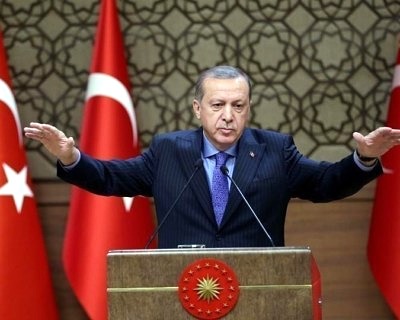
Turkish President Rejep Tayyip Erdogan scored a confident victory in the first round of presidential elections, with the support of 52.5% of voters after processing 98% of the ballots.
In the parliamentary elections, the ruling Justice and Development Party, which is gaining 42.4%, is winning, the Nationalist Party of the National Movement is gaining 11.1%. Thus, the People’s Alliance uniting them receives 342 out of 600 seats in the parliament. Erdogan will be the first Turkish leader after moving to the presidential system, which will finally be established after these elections.
In the early presidential and parliamentary elections on Sunday, Erdogan’s names (from the ruling Justice and Development Party), Mukharrem Inje (from the main opposition People’s Republican Party), Selahattin Demirtash (from the pro-Kurdish People’s Democracy Party), Meral Akhenker (from Good party), Temelya Karamollaoglu (from the Party of Happiness) and Dogu Perincek (from the party “Rodina”).
The main rival of Erdogan Inge is gaining 30.7%, Demirtash – 8.3%, Akshener – 7.4%, Karamollaoglu – 0.9%, Perinchek – 0.2%. In the parliamentary elections, the main opposition People’s Republican Party is gaining 22.7%, Good Party – 10.0%, Party of Happiness – 1.4%, uniting their National Alliance – 34.1%. The pro-Kurdish Party of Democracy of Peoples is also passing into parliament – 11.5% of the vote.
The next election of the president and parliament in Turkey was previously scheduled for November 3, 2019, after which provisions on the presidential system of government adopted in the referendum in April 2017 were to come into effect.
Representatives of the ruling Justice and Development Party (AKP) at first denied information that elections can be held ahead of schedule. However, in April, the leader of the Nationalist National Movement Party (PND), Devlet Bahceli, proposed a pre-term election, motivating it with the need for an early transition to the presidential system. Erdogan immediately accepted this proposal and announced early presidential and parliamentary elections on June 24, after which the relevant resolution was adopted by the Turkish parliament.
The real reason for the appointment of early elections is the deterioration of the country’s economic situation and Erdogan’s concerns about the fall of its rating until 2019.
The undisputed leader of the presidential race was Erdogan, who vigorously conducted his election campaign, building on the economic successes that the country has achieved since 2002, when the AKP led by him came to power. On the pre-election rallies held in many cities of the country, he talked a lot about successes in the fight against terrorism, referring to the recent operations of the Turkish army in the north of Syria and Iraq against the Kurdish formations considered by Ankara as terrorist organizations linked to the Kurdistan Workers Party of Turkey ). The incumbent President of Turkey also claimed that the West was waiting for his defeat at the elections, and urged voters to teach him a lesson.
Inge, previously little known among the voters, a member of parliament from the opposition, conducted a successful campaign, managed to unite around him the opponents of the Turkish leader and reached a rating of about 30%, which is the maximum for his party over the past 40 years.
Inge criticized Erdogan’s policy inside the country, where in recent months the rate of the Turkish lira has significantly dropped and inflation has increased, as well as in Syria. The candidate from the opposition party promised to restore diplomatic relations with Damascus and settle the Kurdish issue. In an interview with RIA Novosti, he also spoke in favor of strengthening good-neighborly relations between Turkey and Russia.
A relatively new person in Turkish politics became Akshener, who earlier left the ranks of the nationalist party because of disagreement with her leader Bahcheli, who supports Erdogan, and in the autumn of last year founded a moderately nationalistic Good Party. The ex-leader of the pro-Kurdish Democracy Party of Demirtas is very popular in the predominantly Kurdish areas of the southeastern Turkish provinces. He had to conduct his campaign in prison, as he was detained in the number of 10 deputies of his party in November 2016 on charges of having links with the PKK and is involved in several lawsuits.